

CATEGORY: Little Pieces Of Life
Alberta
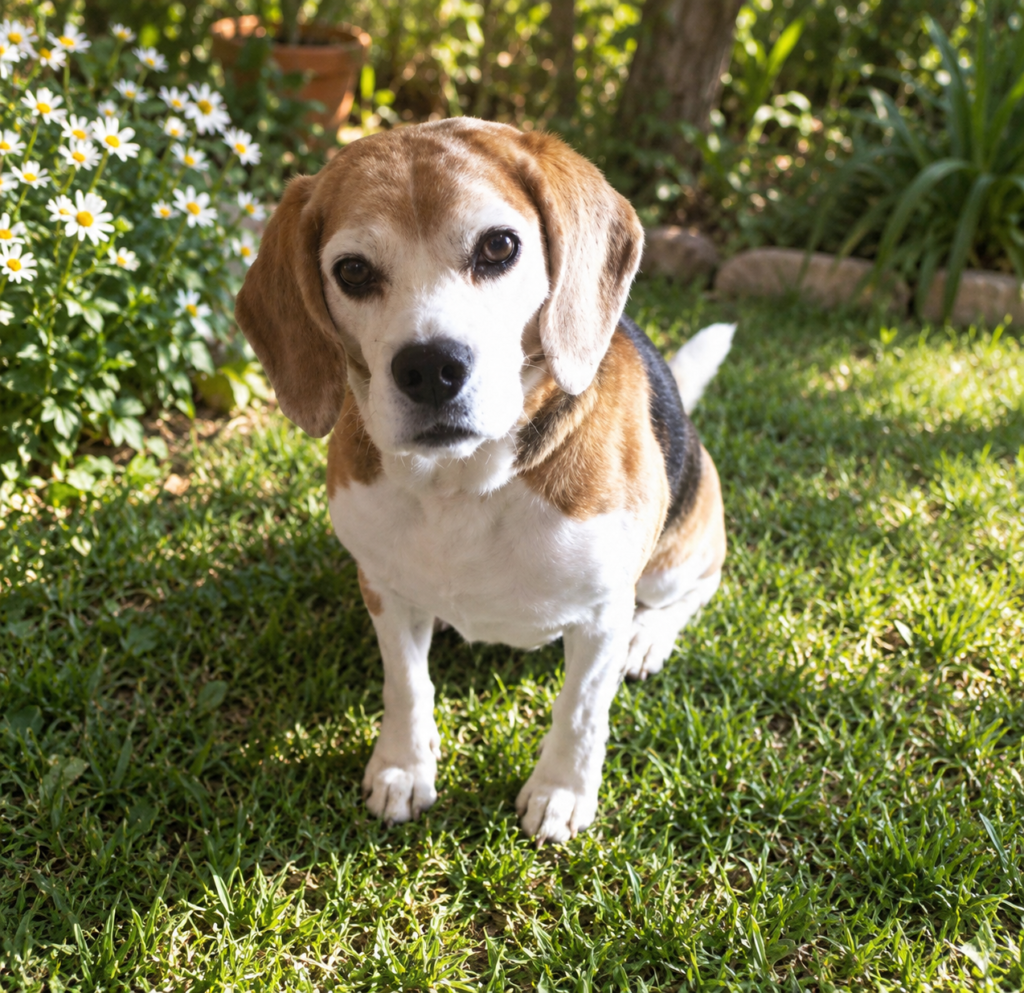
An incredibly intelligent, lovable beagle, with a strong personality, boundless energy, and a remarkable determination to get what she wanted. She was not one to give up easily. If she wanted something, she would find a way to let you know, and she would persist until she succeeded. Especially when it came to a dog treat, her patience would run out almost immediately. Her love of food was one of the most distinctive and amusing aspects of her personality, a little daily performance that never failed to make me smile.
The more I think about her, the more I realize just how unique an animal’s personality can be. Alberta knew what she wanted. She had her preferences, her habits, her own way of communicating with me. She did not need to bark constantly or whine to make herself understood. Often, a single look was enough. I would look at her and feel as though she were smiling at me. I do not know whether a dog smiles in the way we humans understand a smile. What I do know is that there were moments when her face conveyed so much happiness that I could find no other way to describe it.
She adored our adventures in nature. Our endless walks were an opportunity for her to discover the world over and over again. Despite her medium size, she possessed a strength and vitality that often amazed me. She was playful, tireless, and endlessly curious about everything she encountered along the way. And of course, even during our walks, her love of food never deserted her. Alberta could combine exploring her surroundings with searching for a possible treat, as though every walk held the promise of some little culinary discovery.
She loved people, too. She enjoyed their affection, their attention, and the happiness they showed her. And watching her, I often thought about how naturally animals respond to tenderness. Without needing explanations or searching for the right words, they can participate in a relationship with their entire being. A gentle touch, a glance, a moment of play can be enough to create a connection that needs no words.
I particularly remember Christmas. Our home beautifully decorated, filled with lights and ornaments, and Alberta walking among them with a care that always impressed me. She never disturbed anything. She never knocked things over, pulled at decorations, or damaged anything. She seemed to enjoy the festive atmosphere herself, moving through the house as though she understood that everything had its own special place. And today, when I recall those images, I realize that many of our most cherished memories do not come from extraordinary events. They come from small, recurring moments that we once took for granted.
Of all our habits, however, there was one I particularly loved. I would lie down beside her on her cushion and hold her close against me. She would enjoy the contact, while I felt her warmth, the weight of her body, and the closeness we had built over the years. We did not need to do anything. Simply being together was enough.
And I wonder whether this is ultimately one of the most precious gifts an animal’s companionship can offer us. It allows us to share moments in which we do not need to prove anything, explain anything, or become someone different from who we are. Our presence is enough. Just as theirs is.
Eighteen years. When you say those words, they seem like nothing more than a number. But when you have lived those years beside another living being, you begin to understand how much life they contain. How many seasons have passed, how many Christmases, how many walks, how many mornings and evenings. How many times a door opened and she was there. How many times a glance, a movement, or a small habit became part of your day.
Alberta was not merely present in those moments. She was part of them. She had her own place in our home, in our habits, in the rhythm of our lives. And throughout all those years, without our even realizing it, her presence had become as natural as everyday life itself.
Perhaps that is why, when you share eighteen years with an animal, you are not simply counting the time you spent together. You are also counting a part of your own life, a part you can no longer remember without them.
When Time Suddenly Begins to Run Out
Alberta had grown old. Her eighteen years had left certain signs, such as the cataracts in her eyes, small reminders that time was passing for her, too. I knew that, of course. But I could never have imagined how quickly everything would change. Nobody had prepared me for such a rapid deterioration in her health, within just a few hours. It was as though everything that had previously unfolded at its own natural pace had suddenly accelerated, leaving me no opportunity to fully comprehend what was happening.
At first, I refused to believe what I was seeing. I would pick her up, hold her close, and try to convince myself that it was something temporary. A little illness, a difficult day, something that would soon pass, and I would see her getting up again, walking around, demanding the things she loved with her familiar impatience. I wanted so desperately to return to the previous day, when everything I had taken for granted was still in its place.
But the following day brought a sight that frightened me more than anything else. Alberta refused to eat. She, who adored treats and never missed an opportunity for a delicious morsel, no longer showed any interest. I bought her everything she loved. All those little pleasures that I knew would once have made her jump up impatiently, look at me with that familiar expression, and demand her share. I placed them in front of her and waited. I did not simply want her to eat. I wanted, if only for a moment, to see my old Alberta again, to recognize in the smallest reaction some reassurance that I was not losing her.
Then she stopped drinking water. And shortly afterward, she could no longer get up from her bed.
I do not know whether anyone can truly prepare for such a change. To watch a creature who had been overflowing with energy throughout her life, who ran, played, persisted, and fought for what she wanted, no longer have the strength even to stand. The contrast between everything I remembered and what was happening before my eyes was almost unbearable. And the more I understood what was approaching, the more I wanted to hold on to the possibility that I was mistaken.
During those final hours, I held her in my arms for what felt like an eternity. I wanted to feel her close to me, to offer her the warmth and security we had shared for so many years. Alongside my need to care for her, there was another need, deeply my own: to hold her enough to somehow satisfy my longing for her before she was gone. To embrace her as much as I possibly could, to imprint within me the feeling of her body, her presence, everything I had been able to reach out and touch whenever I wanted for eighteen years.
And it was then that I began to understand how strange our relationship with time becomes when a farewell is approaching. Suddenly, every minute acquires a value it never had before. You no longer think about tomorrow in the usual way. You do not make plans. You are in no hurry to finish one thing and move on to the next. You only want to remain there for as long as possible. As though your presence could somehow delay what you fear.
I knew the end was approaching. But I did not want to stop hoping. And I found myself living with two opposing realities at the same time. On the one hand, I could clearly see Alberta’s condition. On the other, I continued waiting for a small movement, a glance, some indication that she might pull through. It was not that I did not understand. It was that I was struggling to bear what I understood.
I wonder whether this is one of the most painful parts of saying goodbye. When the mind has begun to recognize the inevitable, but the heart continues to resist. When you know that time is running out and, despite everything, you keep asking for a little more.
One more morning. One more embrace. A little more time together.
Because however much we know that every life has an end, knowing it is one thing, and watching that end approach someone we love is quite another.
And as I held Alberta in my arms, I began to realize that eighteen years with her no longer seemed nearly enough.
The End
Alberta passed away peacefully, within just a few minutes. I was beside her, along with people who loved us both. Friends who stayed close during those final moments, shared our sadness, and through their presence made that farewell a little less lonely.
I do not know whether there is any way to truly say goodbye to a creature with whom you have shared eighteen years of your life. Even when you know the end is approaching, even when you have watched it coming, the moment it happens still finds you unprepared. Just moments earlier, you could touch them, feel their presence, speak to them. And suddenly, you are faced with the realization that this deeply familiar presence will no longer be part of your everyday life.
I think about how much the presence of people who love us matters at times like these. They cannot change what is happening, nor can they take away our pain. But they can stand beside us, without requiring us to explain our grief or justify its depth. My friends knew Alberta. They were not simply saying goodbye to my dog, but to a creature who had found her own place in their hearts as well. I hold that thought with tenderness. Not because it makes the loss any smaller, but because even within sadness there is comfort in knowing that her final moments were peaceful and that we were not alone.
And then came the silence.
That strange moment when everything has ended, yet you cannot quite understand how everything else can possibly continue. The world keeps moving, people keep talking, life goes on at its usual pace. Except that something has just happened to you that has permanently changed a part of your life.
And then begins something for which nobody can truly prepare you.
The Next Day
The next day, the house was empty. And yet my heart was full of her. Full of our memories, of everything we had experienced together, of her presence, which had left its mark on every corner of our home. It was strange to feel such an immense absence and such fullness at the same time. Alberta was no longer there, but eighteen years of shared life could not disappear overnight. They were everywhere, in the images that spontaneously came to mind, in the habits we had created, even in the way I moved around the house.
Only a week has passed, and there are still moments when I think I hear the sound of her little paws. At other times, I look at the clock and think that her mealtime is approaching. These are movements that happen almost automatically, before my mind has time to remember that everything has changed. For eighteen years, my daily life had developed a rhythm that included Alberta. I did not need to think about when she would eat, when we would go for a walk, or where I might find her in the house. These things were simply part of my life. And now I am discovering that habits do not disappear at the same moment as those with whom we created them.
As I return to our memories, I realize that Alberta did not simply enter my life to offer me companionship. Through her, in a way, I also came to know different aspects of myself. I observed her determination, the persistence with which she pursued what she wanted, her strength, but also the tenderness she could show in the simplest ways. She was a creature with her own character, who never tried to become something different in order to be loved. And living beside her gave me the opportunity to observe not only her, but also the way I loved, cared, responded, and connected.
I feel an overwhelming sense of gratitude for the relationship we shared. Alberta never asked me to become someone else. She did not judge me for my weaknesses, did not become angry with me because I was not in the same mood every day, and never pressured me to change. She accepted me as I was. She could draw me into a game, persuade me to go for a walk, remind me through her enthusiasm that there was always something beyond my thoughts and worries that deserved my attention. And when I was sad, she would look at me with those expressive eyes of hers and then curl up in my arms. She did not know what was troubling me, nor did she need to know. She was there, and that was often enough.
I think about how rarely we allow ourselves to simply exist within a relationship without feeling that we must live up to some expectation. With people, even in our most loving relationships, there are misunderstandings, demands, disagreements, moments when we struggle to understand one another. With Alberta, our communication had a different kind of simplicity. I did not need to explain why I was sad or hide my sorrow from her. I could simply be there, just as she was. And through this everyday togetherness, a deep closeness developed, built not on what we said, but on everything we experienced together.
Perhaps that is why I find it difficult to describe her loss merely as the death of my beloved dog. Because in saying goodbye to her, I am also saying goodbye to an entire period of my life. To the Alberta who waited for me, who stirred me into action, who demanded a treat with her irresistible persistence, who enjoyed our walks, who lay beside me and rested her body in my arms. All of these were small parts of a relationship that grew and evolved every day, without my ever imagining that one day I would have to search for them only in my memory.
And now, during this first week of her absence, I am beginning to understand that grief does not exist only in the moments when we cry or consciously remember someone we have lost. It also lives in those moments when, for a second, we forget that they are gone. In the spontaneous movement of looking toward where they used to be, in the expectation of a familiar sound, in the hour we still instinctively reserve for their needs. It is as though a part of our everyday life continues waiting for them, even when we know they will not return.
I do not yet know what the coming days will be like. I do not know when I will stop listening for the sound of her paws or looking at the clock when it is time for her meal. And I do not feel the need to hurry. Because these small, unconscious gestures remind me how deeply my life had become intertwined with hers.
Alberta is gone, but everything I experienced with her continues to live within me. And at this moment, while her absence is still so recent, I feel that sorrow and gratitude can coexist. I am hurting because I can no longer hold her in my arms. And at the same time, I feel grateful because I had the happiness of holding her close for eighteen whole years.
Life goes on. I have taken up new hobbies, continued working as usual, meeting people, and spending time in nature, which I came to love so deeply with her. I have not stopped doing the things that bring me joy, nor do I feel that I must remain immersed in sadness to prove how much I loved her. There are moments when I laugh, when I enjoy a beautiful day, when my mind is occupied with something new. And there are other moments when a memory arrives unexpectedly and my eyes fill with tears. I no longer see these two experiences as opposites. They are both part of my life right now.
I think we often treat grief as a period during which life must come to a standstill until we feel ready to move forward. But loss does not follow a particular schedule, nor is love measured by how long we remain motionless in the face of it. We can be hurting and still take an interest in what is happening around us. We can seek new experiences, make plans, and enjoy the company of the people we love. One does not cancel out the other.
And when I return to nature, to the places where we walked countless times together, Alberta often comes to mind. I remember her enthusiasm, her tireless curiosity, the determination with which she explored every little corner. I look around and realize that these are not simply places I visited with her. They are also places I learned to love more deeply because of her. Something of the way she enjoyed life has remained in the way I see it myself.
I do not know how my sadness will change with time. Only a week has passed, and I do not feel the need to find answers to everything I am feeling. I only know that I want to continue living with that same spirit of discovery, with the same love for the small joys we shared. And if Alberta has left me anything beyond our countless memories, it is this deep appreciation for the simplicity of everyday life. For a walk, a game, an embrace, for the happiness that can exist in a single moment without anything extraordinary needing to happen.
The next day arrived, just as all the days that follow will arrive. Each will bring its own experiences, joys, and difficulties. Alberta will no longer be beside me to share them as we once did. But she will remain in everything I experienced with her, in everything I learned from her, and in all those things that still move me when I remember her.
For eighteen years, we walked together. Now I continue along my path without her beside me, but with gratitude that she was part of my life. And every time I find myself in nature, where she was so happy, I feel that a small part of that happiness still belongs to me.