
CATEGORY: Little Pieces Of Life
When a Chapter Comes to an End
Mr Vasilis is seventy years old and has spent most of his life working in a machine shop. He started working when he was very young, almost a child, at a time when learning a trade from an early age was quite common. At first, he did the simplest tasks and stood beside the older craftsmen, watching their hands as they worked. He asked questions, tried, made mistakes and tried again, until little by little the work became second nature to him.
The years passed, and at some point the young Vasilis, who once turned to the older craftsmen for answers, became Mr Vasilis, the man the younger ones turned to. Everyone in the shop knew that whenever something difficult came up, his opinion was worth hearing. “Call Mr Vasilis to have a look,” or “Ask Mr Vasilis,” or “Mr Vasilis will know.” He would walk over, take a look and usually find the solution.
For decades, his life followed a steady rhythm. He woke up early in the morning, drank his coffee and left for work at almost the same time every day. At the machine shop, the familiar sounds of the machinery were waiting for him, along with the smell of oil and metal, the tools, the conversations with his colleagues and the little jokes that had become part of their daily routine. There were people there with whom he had spent more hours than he had with many of his friends.
Of course, not every day had been a good one. There were days when he came home exhausted, days when he was irritated, complained about the amount of work he had to do, and told his wife that he was tired and could hardly wait to retire. During those final months, he had even begun to measure time differently. Not by how many years he had worked, but by how much time remained until he could finally stop.
In his mind, retirement looked like a great freedom waiting for him. He imagined mornings without rushing, cups of coffee he would no longer have to drink while watching the clock, more time at home and, at last, the chance to do all those things he had postponed for years.
“I can’t wait to retire and finally have some peace,” he would often say.
And he truly meant it.
Eventually, the day he had been waiting for arrived. Mr Vasilis went to the machine shop for the last time as an employee. His colleagues had decided to give him the kind of farewell that suited a man with whom they had shared so many years of work. When they finished for the day, they set up a table outside, lit the charcoal and cooked together. They opened some wine, raised their glasses, and before long the conversation was filled with stories from the past. They remembered difficult repairs, funny incidents and people who had come and gone over the years. One of the younger men joked that now Mr Vasilis was leaving, they would finally have to learn how to manage on their own. He laughed with them. It was one of those beautiful afternoons you wish could last just a little longer, even if you never say so.
When the time came, he said goodbye to each of his colleagues and, before leaving, turned to the younger ones and jokingly told them not to call him the moment the first problem came up. He was not a man for grand farewells, and he did not want to show how deeply the moment had affected him. Then he closed the door behind him and headed home. On the way, he felt strange. He was happy, emotional, perhaps even a little relieved. What he could not yet know was that, along with that door, an entire chapter of his life had just closed.
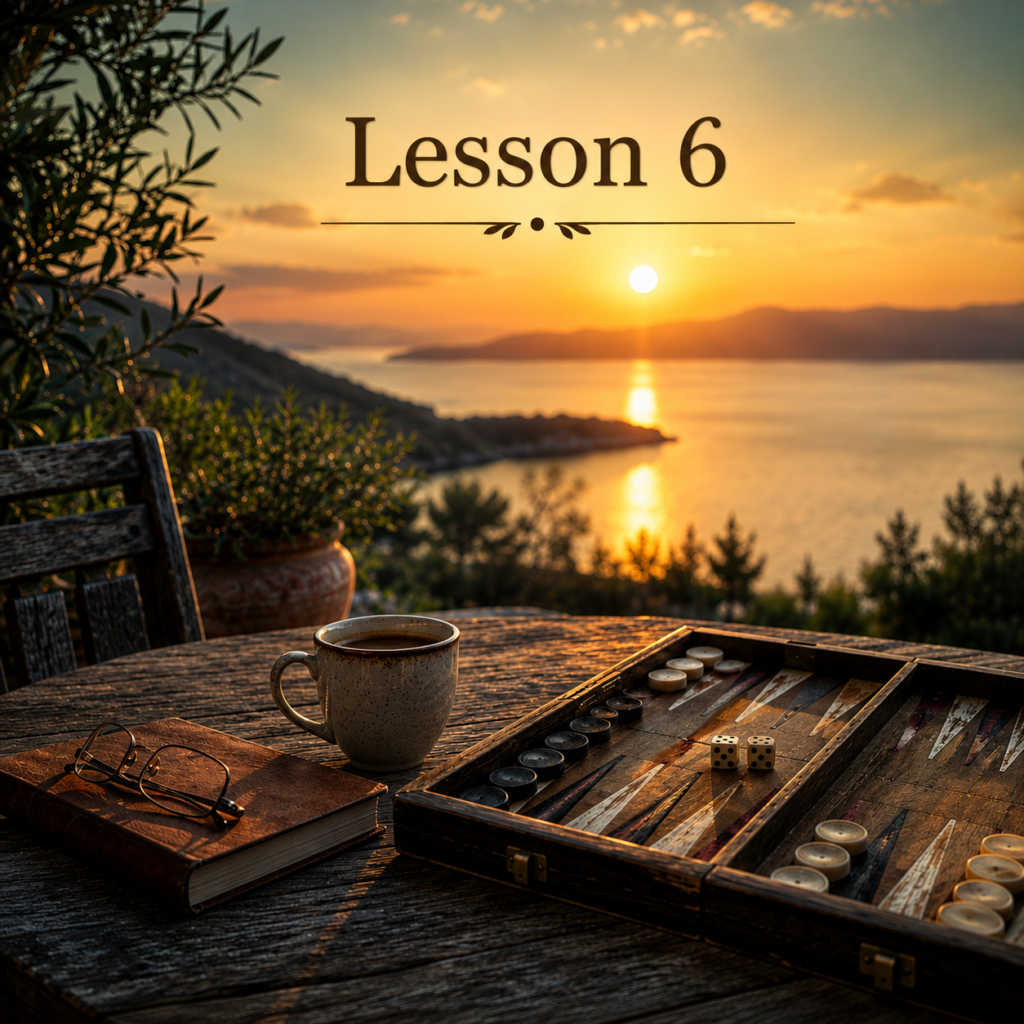
During the first few days, everything was more or less as he had imagined. There was no alarm clock, no rushing, and his morning coffee could finally last as long as he wanted. He took care of a few repairs around the house that he had been putting off, went shopping without constantly checking the time, and during those first afternoons an old friend would come over. They would set up the backgammon board, drink their coffee and spend the time talking and teasing each other. Mr Vasilis enjoyed this new freedom and, whenever someone asked him how retirement felt, he would smile and say that he had not quite got used to it yet.
At first, that was true. It felt more like a holiday than a new life. Somewhere inside him, there was still the sense that after a few days of rest he would put on his work clothes again and return to the machine shop.
Then came the first Monday. Mr Vasilis opened his eyes just before the time he had woken up for so many years. For a few seconds, he looked at the clock and almost automatically thought that he had to get up. Then he remembered that he did not have to go anywhere.
He turned over and tried to fall asleep again. Wasn’t this what he had been waiting for all those years? For a Monday morning when he would not have to get up and go to work? And yet, that morning, for the first time, the freedom he had longed for also felt a little like emptiness.
Little by little, the first days became weeks. The repairs he had saved for “when I retire” were finished, the afternoons playing backgammon could not fill every day, and his new routine began to lose some of its initial excitement. Mr Vasilis now had all the time he had spent years saying he never had, but he did not always know what to do with it.
He was not used to spending his days confined to the house. From a very young age, he had always been on the move. He left in the morning, met people, worked with his hands, grew tired, returned in the afternoon, and his day had a familiar rhythm. Now, for the first time, the hours passed differently. And this change began to bring thoughts to the surface that he had never really had reason to consider before.
Perhaps it was because, for all those years, he had measured time differently. By responsibilities, days of the week, things that needed to be finished, and the years remaining until retirement. Now that retirement had arrived, Mr Vasilis suddenly became aware of just how many years had already passed. The boy who had once walked into a machine shop for the first time was now a seventy-year-old man.
And that thought unsettled him more than he had expected. Perhaps retirement did not simply mean that he had stopped working. Perhaps it was the moment when life was reminding him that he had grown older. Were the years of old age beginning now? Would he continue to be active? Would anyone still need him? Were there still things ahead for him to look forward to, or were the most important years of his life already behind him?
He did not find it easy to say these things to other people. Whenever someone asked how he was doing, he smiled and replied, “I’m fine. I’m slowly getting used to it.” Inside, however, he was trying to understand something much bigger than how to fill the hours of his day. He was trying to discover who he was now that an entire era of his life had ended. And perhaps this was the real separation he had never anticipated: not only from a place and a familiar routine, but also from the image he had held of himself for so many years.
In the days that followed, he began thinking more about everything he had left behind. He missed things he would never have imagined he could miss. He even missed the morning rush, the coffee with his colleagues, the voices rising above the noise of the machines, and that feeling at the end of a difficult day that he had accomplished something. More than anything, though, he missed the feeling that somewhere, someone was expecting him, and that what he did mattered to other people.
That was perhaps the hardest part to explain. Mr Vasilis did not actually want to go back to work. His body was tired, and he knew that the time had come to stop. He was still glad that he no longer had to work such long hours, and he did not regret retiring. And yet, he missed the life he had left behind. For quite some time, these two feelings seemed almost contradictory to him. How could you be happy that something had ended and, at the same time, feel sad because it was over?
Perhaps, then, Mr Vasilis’s separation had not really begun on the day he closed the door of the machine shop for the last time. Perhaps it began later, when he realised that he did not simply have to get used to no longer working. He had to say goodbye to a way of life that had been with him since he was almost a child, so that one day he could discover what might exist beyond it.
During those first weeks, Mr Vasilis tried to fill his newfound time with whatever he could. He went out more, did repairs around the house, met friends and sometimes found an excuse to stop by the machine shop. Before long, however, he realised that he did not simply need to fill the hours of his day. He needed to create a new everyday life that held meaning for him. And that proved more difficult than he had imagined.
For the first time in so many years, no one else was setting his schedule. No one expected him at seven in the morning, no one was telling him what had to be finished by midday, and no phone would ring because something had broken and someone needed his opinion. He was beginning to understand that retirement came with a responsibility he had never considered before: he now had to decide for himself what he wanted his life to look like from this point on.
It did not happen overnight. For a while, he continued to miss the place where he had spent most of his life and to compare his new routine with the old one. Slowly, however, he began turning his attention towards things that had always been there but had been put aside for “when there is time.”
One day, a neighbour asked him for help with an old machine he could not repair. Mr Vasilis went over to take a look and, almost without realising it, found himself once again explaining, demonstrating and using everything he had learned over so many decades. Only this time there were no working hours, no boss and no obligation. There was simply the pleasure of still being able to offer something he knew how to do well.
Perhaps that was when he began to see retirement differently. Leaving the machine shop did not mean that he had to leave behind everything he had become over the years. His experience, his knowledge, his work ethic, his need to create and to feel useful did not belong to that place. They belonged to him. What had ended was simply one particular way of expressing them.
For Mr Vasilis, that nostalgia also carried a sadness for a chapter that had closed for good. An era of his life, however beautiful or difficult it may have been, could not return. Perhaps that was what troubled him most. Retirement had arrived as something he had wanted and looked forward to, but it had also brought with it a sense of loss he had never anticipated.
It was a kind of quiet grief for everything that was ending with it. For the years that had passed, for the person he had been during those years, for a way of life he had once taken for granted and which had now become a memory.
There were days when this thought weighed more heavily on him. He was not necessarily unhappy, nor did he regret his decision. He simply felt that he needed time to say goodbye. Perhaps this was something he had not allowed himself at first, because after waiting so many years for retirement, he believed he was now supposed to do nothing but enjoy it.
Gradually, he understood that he could feel both things at once. He could be happy about what was opening up ahead of him and, at the same time, feel sad about what he was leaving behind. His sadness did not mean that he did not want to move forward. It simply meant that what was ending had mattered.
Because some chapters cannot be closed simply by turning the page. We need a little time to stand before them, recognise what they gave us, and say goodbye to the person we were within them. Only then does real space begin to open for whatever comes next.
Mr Vasilis needed time. Perhaps more than he had expected. He did not wake up one morning suddenly at peace with his new life, nor did all the thoughts that had troubled him during those first months simply disappear. Slowly, however, he stopped seeing retirement as a reminder that the years had passed and began to see it as another period of his life, one that could still be filled with things that meant something to him.
The afternoons playing backgammon became more frequent, his walks became longer, and the time he spent with his wife took on a different quality. He also discovered that he enjoyed small building and repair projects, not because he had to do them, but because creating things with his hands still brought him pleasure.
Most importantly, he began to understand that the end of one important role in his life did not mean the end of his usefulness, his creativity or his need to feel alive. He was still the same person, with the same knowledge, the same experiences, the same sense of humour and the same desire to contribute. He simply needed to discover new ways of expressing them.
The nostalgia never disappeared. Nor did it need to. There were still moments when he remembered the years that had passed and felt emotional. But now he could remember them without feeling that he needed to return to them. They had been a large and important part of his life, but they were not his entire life.
Perhaps, in the end, that was what Mr Vasilis had managed to do. He did not try to keep open a chapter that had already closed, nor did he try to erase it in order to move forward. He carried it with him as part of his journey and, at his own pace, began to look a little more towards what lay ahead.
Because when one chapter comes to an end, it does not necessarily mean that something within us ends as well. Sometimes, it simply means that the time has come to discover what else might begin.