
CATEGORY: Stories That Left Their Mark
Although we are nearing the end of summer, today is cloudy and grey and, except for the heat, it feels like an autumn afternoon.
I am sitting at my desk, listening to music from The Little Prince by my beloved Evanthia Reboutsika playing softly from my laptop. I let it play for a while until, almost without thinking, I get up and walk over to my bookcase.
I begin searching among the books. Slowly, I run my fingers along their spines until my eyes finally rest on the one I have been looking for.
The Little Prince.
I take it in my hands and spend a moment looking at the cover. The little boy with the blond hair stands at the edge of a tiny planet, gazing in wonder at the world around him.
I settle into my armchair and begin leafing through the pages. Some of them are almost filled with my own handwritten notes, underlined words and phrases, little traces left behind from previous readings.
I turn back to the cover.
I smile as I look at the little boy. He is so small, and yet, if you forget his height for a moment, there is something about the way he carries himself that reminds me of a grown man.
I close my eyes. With the gentle sounds of the music still playing and the book resting in my lap, I slowly surrender to a magical journey.
And then I see myself there.
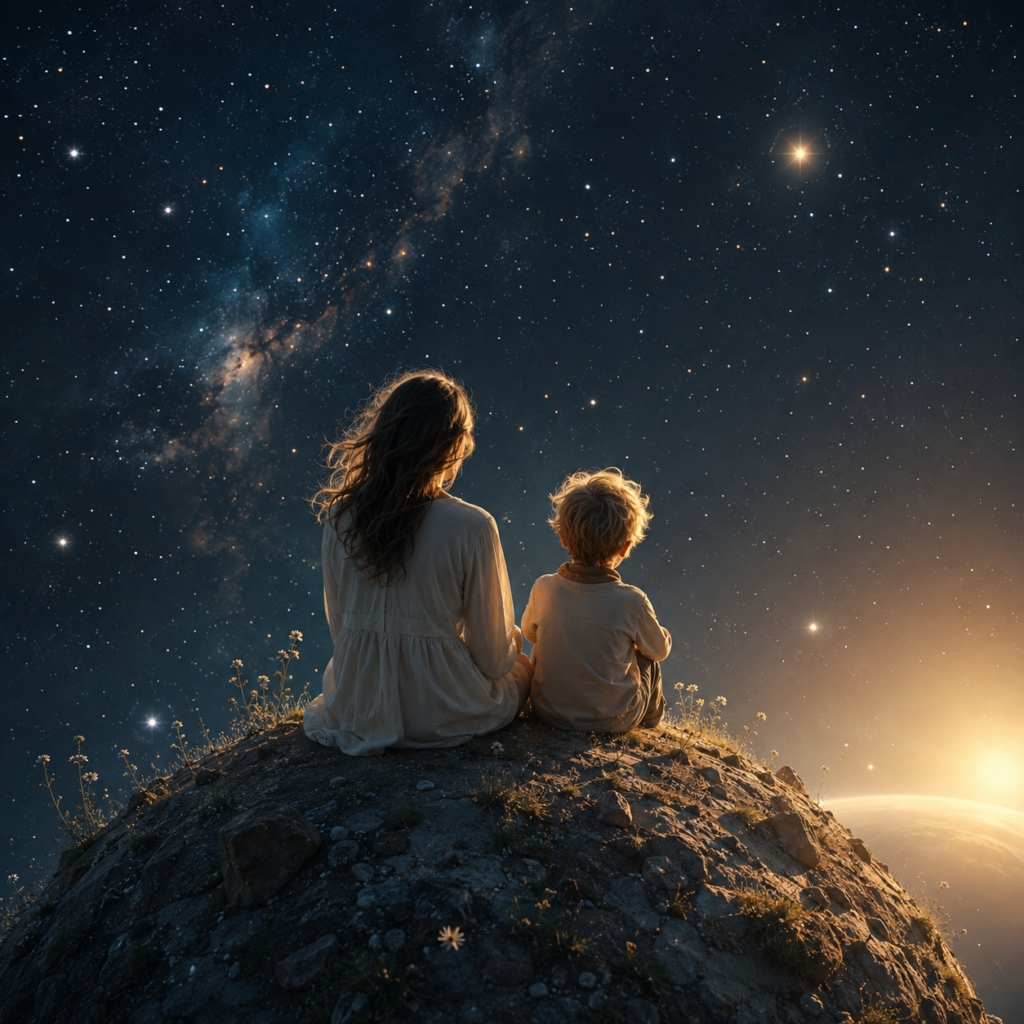
Sitting beside the little boy on that strange, tiny planet. We do not speak. We simply sit side by side, looking at the sun, the stars, the endless universe surrounding us.
How strange it feels to see my legs dangling over the edge of a planet. It is so small that it looks more like an enormous rock lost somewhere in the universe. I find myself thinking that if I stood up and walked for a while, I could probably make my way around the entire thing in just a few minutes.
But stranger still is the fact that I am sitting beside a little boy and we are doing none of the things one might expect a child to do. We are not running, we are not playing, we are not laughing at something silly.
We simply sit beside each other.
Our legs dangling into the void, we watch the sun as though we were seeing it for the very first time.
For a moment, I turn and look at him. I am not sure whether I should say something or whether it would be better to remain silent. There is something unusual about this child. Something that makes me forget how young he is.
Perhaps it is because he does not look at the world the way children usually do.
Or perhaps we grown-ups have simply forgotten how children truly see the world.
After a while, he turns and looks at me.
“Why are you smiling?” he asks.
“I don’t know… This whole thing seems a little funny to me. You and me, sitting on the edge of a planet.”
He looks puzzled.
“Why is it funny?”
I open my mouth to answer him, but in the end I say nothing. What am I supposed to explain to him? That we grown-ups have learned to consider so many absurd things perfectly normal that, when something beautiful happens, that is what seems strange to us?
“I don’t know,” I finally say.
He frowns.
“Grown-ups say ‘I don’t know’ an awful lot.”
“Didn’t I say it when I was little?”
“You tell me.”
I reach back into my memories, trying to remember. What was I like as a child? Did I ask questions all the time? Was I curious about everything? And when did I stop?
Without quite realizing it, I begin observing the woman I am today. I do not always ask questions anymore. Quite often, I assume. Other times, I draw my own conclusions—with remarkable success, I must admit, especially when they happen to be wrong. And then there are those moments when something bothers me, when I do not understand it or simply do not like it, and yet, instead of asking one simple “why?”, I prefer to come up with the explanation myself.
We grown-ups, I think, have a peculiar talent: we create entire stories in our heads and then become upset about them as though they had actually happened.
“As I grew older,” I tell him, “I no longer had time to be curious.”
My days became filled with obligations. Things I had to do, things I had to learn, other things I wanted to acquire. New experiences, new goals, new needs. There was always something waiting around the next corner and, almost without noticing, somewhere along the way I stopped living carefree.
And now I am sitting on this strange little planet, my legs dangling into the void, wondering.
When was the last time I truly looked at the stars? When did I last stop and watch the sun without caring what time it was? When was the last time I allowed my mind to wander without giving it a destination?
When was the last time I daydreamed?
The strange thing is, no one ever told me to stop daydreaming. I cannot remember anyone taking me by the hand one day and announcing that all of that was over now because I had grown up.
It simply happened.
Little by little.
Dreams became goals, wishes became plans, and spontaneous moments began requiring space in my calendar. Even rest somehow acquired a schedule.
I smile at the thought.
In the end, we grown-ups manage to accomplish something truly remarkable: we fill our lives so completely that eventually there is no time left to live them.
For a while, we both remain silent. He gazes off into the distance, while I absentmindedly play with a small pebble beside me.
“You know,” I say after a while, “in the end, you and I aren’t so different after all.”
He turns and looks at me.
“I’ve travelled a lot too,” I continue. “Not from planet to planet like you. My journeys happened here, on Earth. But now that I think about it, I met people much like the ones you met.”
“Strange people?”
I laugh.
“Very. The only difference is, back then they didn’t seem strange to me at all.”
I lean forward and toss the pebble into the void. I watch it for a moment until it disappears from sight.
They didn’t live on distant planets, and they didn’t wear royal robes. They were people from my everyday life. People who always needed to have the last word, who measured their worth by their position, their money, the recognition they received, or the way others looked at them. I met people who wanted to be admired more than they wanted to love, and others who collected possessions, titles and achievements as though all of it might somehow guarantee that they would never feel small again.
And the more I think about it, the harder it becomes to look at them from a distance. Because I admired some of those people. I followed some of them. I loved some of them. And, if I am completely honest with myself, there were times when I, too, measured my life by the wrong things—by what I had achieved, what I had acquired, how much I had managed to accomplish, whether I was good enough in the eyes of others.
He looks at me seriously.
“And were they happy?”
I take my time before answering.
“I don’t know… Perhaps some of them believed they were.”
He remains silent for a moment, looking up at the stars.
“I think I trust the things people still haven’t managed to explain, measure or control,” he says. “And I’m a little wary of all the things they create themselves and then decide they must have in order to be happy.”
I look at him without saying a word.
For such a little boy, I think, he has an irritating way of saying very simple things that we grown-ups need half a lifetime to understand.
Then he turns towards me.
“Did you ever learn how to say goodbye?” he asks. “How to leave when it’s time, and how to let other people leave too… without believing that every goodbye means you’ll end up alone?”
I stare at him, caught off guard. Only moments ago, we were talking about people, about everything they chase, everything they struggle so hard to acquire. And yet now I find myself wondering whether perhaps the hardest thing in life isn’t acquiring at all.
Perhaps it is knowing when to let go.
People. Relationships. Dreams that once belonged to you but no longer fit the person you have become. Even old versions of yourself that you insist on carrying around simply because they are familiar.
His questions catch me unprepared. Suddenly, the strange planet beneath my feet seems to shrink, becoming nothing more than a speck in the endless universe, and I feel as though I am suspended in eternal darkness.
I look around, and for the first time the stars no longer seem beautiful. They seem distant. Unreachable. My legs dangle over the void and, without even realizing it, I grip the rock beside me with both hands, as though I am afraid something might pull me away.
A strange tightness rises in my chest. I think of all those who left. Those I allowed to leave, and those I held on to far longer than I should have, simply because I was afraid of the emptiness they would leave behind.
I close my eyes for a moment.
Perhaps, I think, we aren’t really so afraid of losing people.
Perhaps what frightens us more is discovering who we will be when they are no longer there.
I have barely recovered from his last question when the next one arrives, apparently determined to finish me off completely.
“Are you free?”
I stare at him.
I am beginning to suspect that this little boy, with his innocent eyes and blond hair, is considerably more dangerous than he looks.
“Of course I am,” I reply almost automatically.
He says nothing.
And his silence is already beginning to get on my nerves.
Because I know he wasn’t asking whether I can open a door and walk away. He was asking whether I can leave without taking with me all those invisible chains I have forged for myself over the years. Obligations. Shoulds. Fears. Expectations. People I don’t want to disappoint. Things I once chose and am now afraid to leave behind.
I look at him. He could stand up at any moment and travel to the next planet. He didn’t even want his sheep to be tied up.
And I, who only moments ago answered with such certainty that I was free, begin to wonder just how many chains a person can carry without a single one of them being visible.
I am beginning to dread his next question.
I glance around, wondering whether I could perhaps move a little farther away from him without making it too obvious.
Hopeless.
This planet is tiny. I could move to the other side and I’d still practically be sitting next to him.
I sigh and stare into the endless space ahead of me.
“Any idea when the next bus to Siberia is coming?” I ask.
He looks at me, puzzled.
“What’s a bus?”
“Never mind. Ignorance really is bliss.”
I smile to myself and turn back towards the stars. He says nothing. He simply sits quietly beside me, gently swinging his legs over the void.
For a few moments, there is silence.
And, much to my relief, he doesn’t ask me anything.
And there, in the silence, I realize something that had never occurred to me all these years. The Little Prince is free, yes. But he is also alone. Perhaps that is why he wanders from planet to planet. He is looking for people, looking for friends, looking for someone with whom he can share all the things he sees and feels. But he does not want to be chained to them. Nor does he want to chain them to him. What he wants, I think, is something far more difficult: for them to meet as free souls and celebrate their freedom together.
Hmm… I had never thought of it that way.
Perhaps freedom does not mean belonging nowhere and to no one. Perhaps it means always having the right to choose where I want to belong, whom I want beside me, and which commitments are worth making my own.
I turn my eyes slightly and steal a glance at him.
Thankfully, he is still looking at the stars.
I am definitely not ready for another question.
Something seems to have fascinated him again. I have no idea what he is looking at, but he seems so peaceful, so completely absorbed, that for a moment I envy him.
What I wouldn’t give to slip inside his mind for just a little while. To see what he sees. To hear what he is thinking.
And then I realize what I have just said.
To see what he sees…
That’s it.
Children have an almost magical way of looking at the world. They can discover something extraordinary in a cloud, stop in front of an ant as though they were witnessing the most important event of the day, gaze at the moon without wondering whether they are wasting their time. They notice the rare beauty all around us that we grown-ups have learned to rush past as we struggle to bring some kind of order to the strangely chaotic lives we have created.
I look at him again.
I envy his serenity. But more than that, I envy the way he can still look at something without needing it to serve any purpose at all.
Suddenly, I remember a little souvenir I once brought home from a holiday on an island. I have no idea why it comes to mind now. There was a phrase written on it:
“Spread your wings.”
Could it be time for me to turn the page in my life?
There it is—another kind of freedom I had forgotten. The freedom to turn the page. To look at everything you have lived through, without denying it, without throwing it away, but deciding that you are not obliged to remain there forever.
How easy is that, I wonder?
Not at all, I suppose.
Impossible, though?
No.
I sneak another glance at the little fellow beside me. If I asked him how someone turns the page in their life, I would bet anything that he wouldn’t start listing everything that could go wrong. His eyes would open wide, and he would think of everything that might go right. New places, new people, new joys he does not even know exist yet.
I smile.
If the child inside me has not died of boredom after all these years of adulthood, perhaps I still have a chance to save her.
Or, who knows?
Perhaps she is the one who will save me.
I turn towards him and, for reasons I cannot quite explain, feel the need to share all these thoughts with him.
“You know something, my Little Prince? Along the road I choose when I spread my wings, I will meet people who will judge my decision. Some may laugh at it, others will try to discourage me, and there may even be those who will make me doubt myself. They’ll make me wonder whether I can do it, whether I should, whether it’s too late, whether it’s worth the effort.”
I take a deep breath.
“But I’ve made my decision. This time, I won’t let them get to me. And do you know why? Because this dream is mine. It is a little treasure I have carried inside me since I was a child, one I was too afraid to follow for years. I buried it beneath fears, obligations, and all those ‘somedays’ we use when we haven’t yet found the courage to say ‘today.’”
I lift my eyes towards the sky.
Among all those stars, one suddenly seems to shine a little brighter than the rest.
I smile.
“That is my bright star. And this time, I’m going to follow it.”
“Then follow it,” he says quietly. “Just make sure you look carefully at what you are leaving behind before you go.”
I look at him, puzzled.
For a moment, he lowers his eyes.
“Sometimes you have to travel very far away before you understand how important something was when it was right beside you.”
His words make me turn and look at him. For a moment, something changes in his face. That carefree serenity disappears, and in its place comes a shadow that seems entirely out of place on such a young boy.
“Are you talking about your rose?” I ask hesitantly.
He does not answer straight away. He lowers his gaze and begins absentmindedly tracing patterns in the soil beside him with his finger.
And then I realize that there is probably one thing that never changes, whether you are a child or a grown-up.
When the conversation turns to love, we all need a little time before we answer.
I reach out and gently stroke his blond hair.
“You were too young to know how much you would come to love it,” I tell him. “Then again, perhaps none of us knows at the beginning. Love doesn’t come with an instruction manual.”
He smiles, and I continue.
“As I grew older, I realized that saying ‘I love you’ is not enough. You have to learn how to listen, too. To give without constantly keeping score of what you will receive in return. To say you’re sorry when you hurt someone, even when you didn’t mean to. To forgive, when you can. To be kind not only when everything is going your way, but especially when it isn’t.”
I pause for a moment.
“And perhaps the hardest thing of all is learning to love someone without constantly trying to change them. To listen when they speak instead of simply waiting for your turn to answer. To let them be different from you. To give them the space to bloom in their own way.”
My eyes settle on him.
“Perhaps, in the end, my Little Prince, we don’t learn about love when we find it. We learn about love while trying not to lose it.”
I look into his eyes and, for a moment, it is as though I can see my own Little Prince reflected in them. The child I once was, the one I thought I had left somewhere behind in my hurry to grow up.
But she is still here.
Perhaps a little forgotten, a little neglected, perhaps even terribly bored after all these years of serious adulthood.
But she is here.
She still looks at the stars. She still wants to ask “why?”, to love without keeping score, to forgive, to dream, to spread her wings and believe that somewhere out there, there is always a new world worth discovering.
I smile and close my eyes.
And when I open them again, I am back in my armchair. The music is still playing softly from my laptop, and the book is still resting in my lap.
I look once more at the little blond boy on the cover.
Only now, I no longer see him.
I see myself.