

CATEGORY: Stories That Left Their Mark
Recently, while reading an article about Michelangelo, the great Renaissance artist, I came across something that particularly caught my attention. It was a psychological concept bearing his name, one that connects the art of sculpture with human relationships in a rather unexpected way. I must admit that I had never encountered it before and, as I began reading more about it, I realised how beautifully it describes something we can recognise in everyday life: the way one person can help us discover and develop aspects of ourselves that may have remained hidden for years. It is known as the “Michelangelo phenomenon”, a concept that made me reflect differently on the significance of another person’s presence in our lives. And because I believe it is worth understanding the many ways, both small and significant, in which we influence one another, I wanted to share with you what I discovered, along with some thoughts inspired by this fascinating meeting of art and psychology.
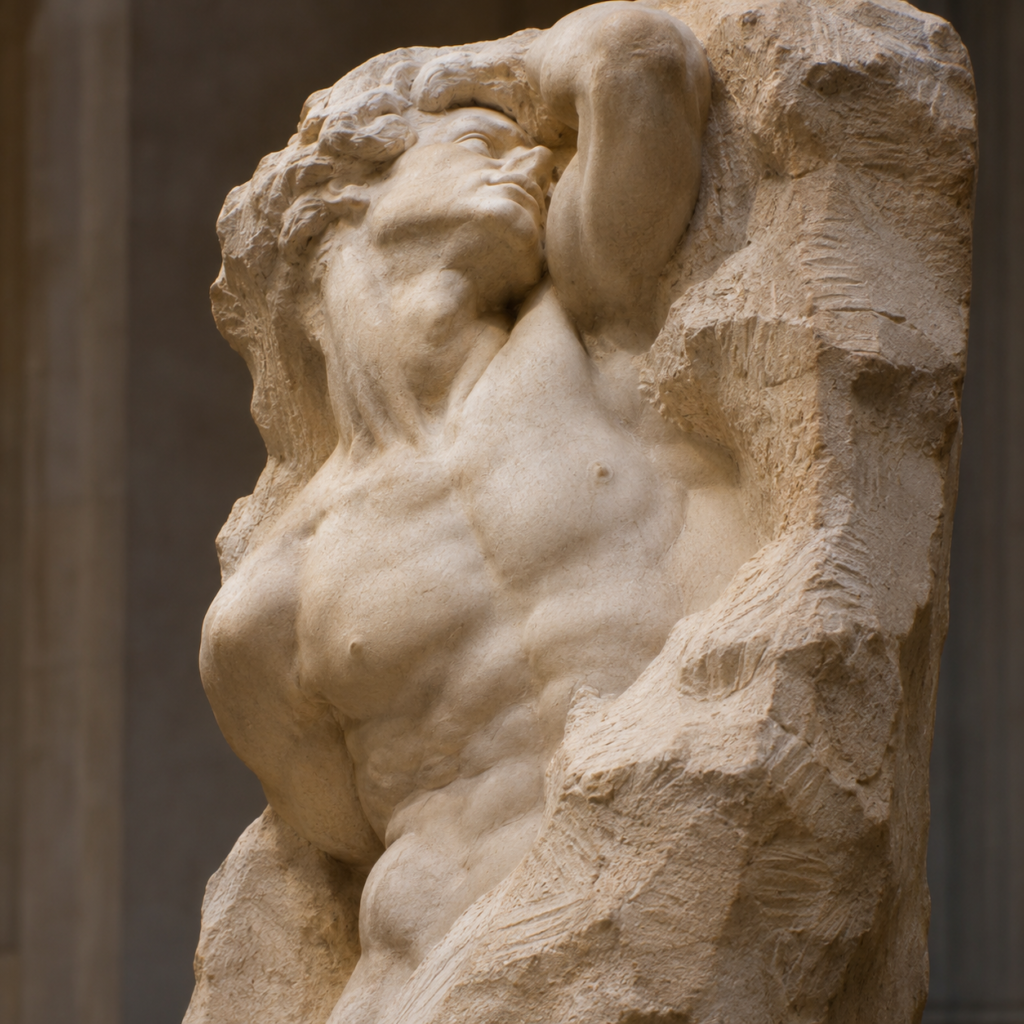
The Michelangelo phenomenon is a concept in psychology that describes how people, through their close interpersonal relationships, can contribute to one another’s personal development. Its name is inspired by the philosophy associated with Michelangelo’s sculpture, according to which the figure already exists within the marble, and the artist reveals it by removing the excess stone. Something similar can happen in human relationships. When a partner recognises our potential, respects our wishes and encourages us to pursue our personal goals, they can help us move closer to the person we ourselves wish to become. In psychology, this desired version of ourselves is called the “ideal self”. It does not refer to a perfect person, but rather to the personal vision each of us holds of how we would like to develop. The most important aspect of the phenomenon is that this development is not imposed by someone else. It is not about trying to change our partner according to our own expectations, but about creating a relationship in which each person feels they have the acceptance, trust and freedom to develop those aspects of themselves that truly matter to them.
The Story of Myrsini and Achilles
Myrsini had loved painting since she was a little girl. She could still remember the afternoons she spent in her bedroom, sitting on the floor with her paints spread around her and her hands stained with colour. She could paint for hours without noticing the time passing. She was not concerned about whether her drawings were beautiful or whether anyone else would like them. The joy she felt while creating was enough. As she grew older, however, her life took a different direction. Her studies, work, family responsibilities and the demands of everyday life gradually began to limit the time she devoted to herself. At first, she would say that she would start painting again once things settled down. Later, when someone asked whether she still painted, she would smile and reply that those days belonged to another time. So many years had passed that she had begun to believe that this creative side of herself had disappeared for good.
Achilles knew that Myrsini had painted in the past, but he had never fully realised how important it had been to her. One afternoon, while they were sorting through some old boxes together, they came across a large folder filled with drawings. Myrsini sat beside him and began showing him her artwork, remembering when and how she had created each piece. She spoke with an enthusiasm Achilles had never seen before. He noticed the way she touched the papers, the emotion in her voice and the smile that appeared whenever she recognised one of her old creations. When he asked why she had stopped, she shrugged. She explained that her responsibilities had increased, that there was no longer enough time and that, in any case, there was little point in pursuing something at which she would never truly excel. Achilles did not try to convince her that she was wrong. He listened carefully and, when she had finished, asked whether she missed painting. Myrsini remained silent for a moment. It was a question she had not asked herself in many years. Eventually, she admitted that she missed it far more than she had wanted to believe.
Over the following days, Achilles did not keep bringing up the subject, nor did he try to turn her old passion into a new goal that she absolutely had to achieve. However, whenever Myrsini mentioned an art exhibition she had seen or a workshop in their neighbourhood that had caught her attention, he showed a genuine interest in hearing more. At one point, she expressed a wish to buy some paints and try again. Almost immediately, however, doubts began to surface. She said that too much time had passed, that perhaps she had lost her ability and that she would be disappointed if she discovered she could no longer create anything that satisfied her. Achilles listened and said something she would remember for a long time: “You don’t have to paint the way you used to. You can discover how you paint today.” He did not promise her that she would become a great artist, nor did he try to make her doubts disappear through exaggerated praise. He simply reminded her that she did not need to prove anything to anyone in order to return to something she loved.
Little by little, Myrsini began painting again. At first, she devoted a little time to it at weekends. Then she decided to take classes and eventually created a small corner of their home dedicated entirely to her painting. Achilles supported her in ways that were not always obvious. He took on some of their shared responsibilities when she had a class, respected the time she wanted to spend alone in front of her canvas and did not treat her interest as something less important than his own activities. There were, of course, moments when they had to change their habits. Some afternoons that they had previously spent together were now times when Myrsini preferred to paint. On certain Sundays, she wanted to visit an exhibition or attend a workshop. Achilles did not always find these changes equally easy to accept. He, too, had to adapt, recognise his own needs and discuss with her how they could preserve their time together without restricting their individual interests. His support did not mean neglecting himself. It meant recognising that Myrsini’s personal development deserved a place within their relationship.
Over time, the change in Myrsini began to become noticeable in other areas of her life. She had not simply taken up an enjoyable pastime. She had begun to trust her own wishes more, to express what she wanted without feeling that she had to justify it, and to recognise that her personal fulfilment was not something she always had to place last. Sometimes she returned from the workshop excited; at other times, she was disappointed by a painting that had not turned out as she had imagined. Achilles did not rush to reassure her every time, nor did he believe he had to find a solution to every difficulty she encountered. He had learnt to listen to her, to take an interest in her experiences and to allow her to discover for herself how she wanted to move forward. Myrsini, for her part, began to understand how important it was to offer Achilles the same freedom. To take an interest in his wishes, even when she did not share them, and not to expect him to be constantly available to meet her own needs.
A few years later, Myrsini took part in a small group exhibition for the first time. She was standing in front of one of her paintings when Achilles approached and asked how she felt. She looked at her work for a moment and told him that she was happy, not so much because her painting was being exhibited, but because she had rediscovered something she had believed lost for years. She also told him that she did not know whether she would have dared to begin again without his encouragement. Achilles smiled and reminded her that she had made all the decisions, devoted the time, faced the difficulties and created the paintings. He had simply been there beside her.
And perhaps this is the most meaningful aspect of their story. Achilles did not create the artist within Myrsini. She had existed long before he met her. He did not decide who she should become, impose a goal upon her or attempt to shape her personality according to his own expectations. He listened to her, trusted her and helped her create the conditions in which she could pursue a desire that was entirely her own. And through this process, their relationship developed as well. Because one person’s personal growth does not have to threaten the other. It can become an opportunity for two people to get to know each other again, discover new sides of one another and build a relationship in which neither person has to make themselves smaller for the other to grow.
Myrsini, Achilles and the Michelangelo Phenomenon
The story of Myrsini and Achilles helps us understand how the Michelangelo phenomenon can manifest itself within a human relationship. Achilles did not discover a talent that Myrsini was unaware of, nor did he suggest a new way of life. He recognised the importance of an aspect of herself that the demands of everyday life had gradually pushed aside. His interest went beyond admiring her drawings. He noticed the joy with which she spoke about them, listened to her doubts and offered her the encouragement she needed to decide for herself whether she wanted to return to painting. He did not try to persuade her that a remarkable artistic career lay ahead of her, nor did he associate her worth with the success she might achieve. What mattered to him was that painting was something meaningful to Myrsini. And that was enough to make him want to support her.
This is precisely the essence of the Michelangelo phenomenon. Within a close relationship, one person can contribute to the development of another by recognising and encouraging those qualities that are connected to the person they themselves wish to become. Just as, in the sculptor’s metaphor, the figure appears to emerge from the marble, so too, in human relationships, a partner can help bring to light abilities, desires and characteristics that have not previously had the space to develop. There is, however, one essential difference. A human being is not a block of marble waiting for someone else to give it form. Each person has their own personality, values and the right to decide in which direction they wish to grow. The partner’s contribution, therefore, does not lie in attempting to shape the other person, but in their ability to recognise and support that person’s own aspirations.
In Myrsini’s case, Achilles’ attitude was particularly important because his support was not limited to words. His encouragement was accompanied by everyday actions, by his willingness to share their responsibilities, by his respect for her personal time and by his acceptance of the changes that painting brought to their relationship. At the same time, Myrsini did not have to meet any particular expectations of his in order to retain his love and appreciation. She was free to try, to be disappointed, to change her mind or even to give up painting again if she discovered that it no longer expressed who she was. This freedom is especially important because personal development cannot be based on the fear of disappointing the person who encourages us. It needs to remain a free choice, even when our journey does not unfold as we originally imagined.
It is also worth noticing that Myrsini’s development did not concern her alone. As she began to claim more space for her personal wishes, Achilles had to reconsider some of his own habits and expectations. Their relationship could not remain exactly as it had been, because the people within it were not remaining unchanged. And perhaps this reveals another important aspect of the phenomenon: the ability to support our partner’s development without experiencing it as a threat to our place in their life. To be able to take pleasure in their growing confidence, in their discovery of new interests or in their increasing independence, even when this means that we, too, must adapt to a different daily routine.
Myrsini did not become a different person because of Achilles. She became more fully the person she herself wished to be. And Achilles did not need to assume the role of someone who knew better than his partner what was good for her. It was enough to observe her with genuine interest, listen to her attentively and respect her choices. This is perhaps the most beautiful aspect of the Michelangelo phenomenon: the possibility of being a positive presence in another person’s development without claiming credit for their transformation. To stand beside them as they discover their abilities and to recognise that their journey, decisions and achievements belong, above all, to them.
Because, ultimately, what matters is not looking at the person we love and imagining who they could become according to our own wishes. It is being genuinely interested in discovering who they wish to become and asking ourselves whether, within our relationship, we offer them the space to find out.