
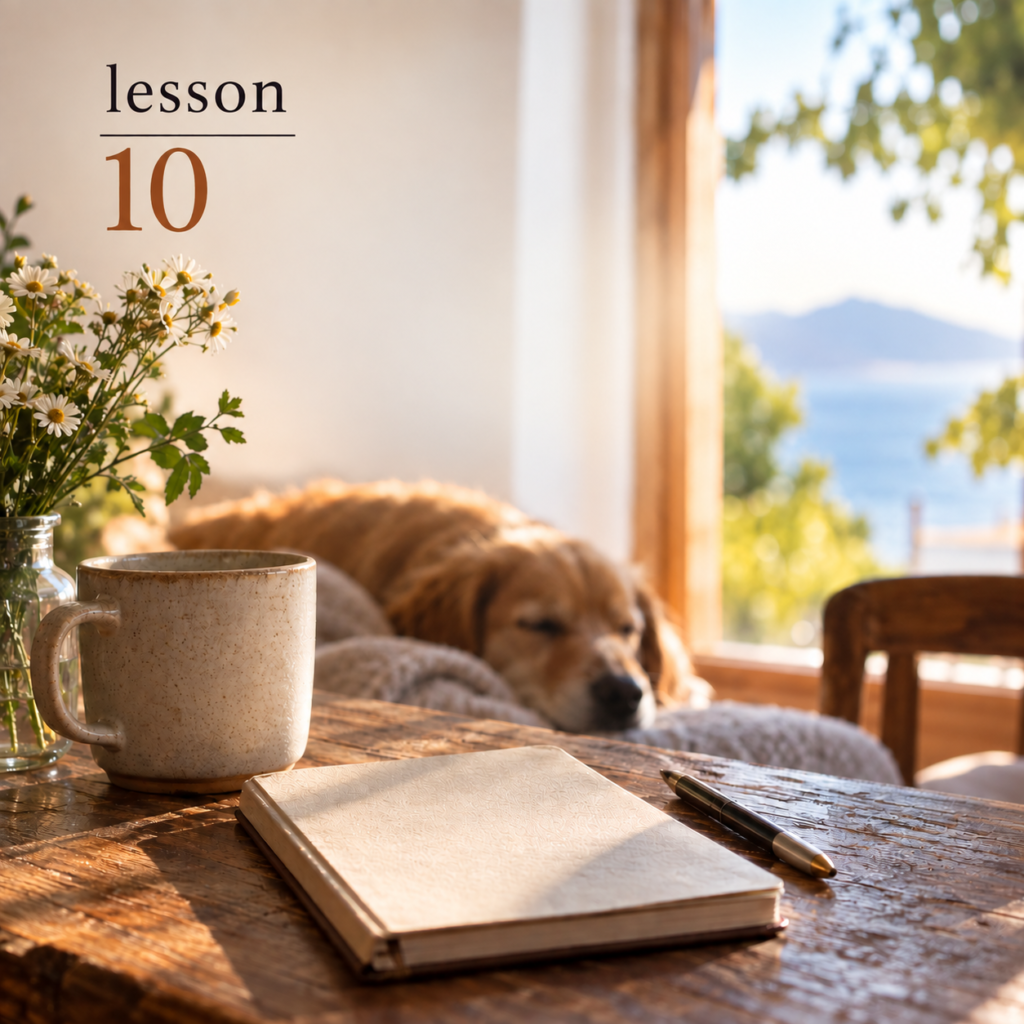
CATEGORY: Little Pieces Of Life
“I Am Here”
Thursday, September 17, 2026
I am grateful for:
My wonderful friends.
My dog. She is the best companion on my walks.
Waking up in the morning. I am here. I am healthy.
Having an abundance of water, electricity, and food.
My computer. An important tool in my work.
Several years ago, I read an article about a study that caught my attention. The idea was remarkably simple: take a few minutes to write down the things we feel grateful for. They didn’t have to be anything significant, nor did anything extraordinary have to have happened that day. All we had to do was turn our attention, for a moment, to what was already present in our lives and usually went unnoticed. The study suggested that such a simple habit could be associated with more positive emotions and a greater sense of well-being.
I decided to give it a try. I took a notebook, wrote down the date and underneath it, “I am grateful for:”. And then I stopped. As simple as the exercise had seemed when I first read about it, it turned out to be surprisingly difficult when the time came to actually do it. I didn’t know what to write.
The first thing that came to mind was perhaps the most obvious of all: “I am here.”
I wrote it down and looked at it for a while. I am here. I woke up this morning, got out of bed, and another day had just begun for me. Underneath, I wrote one more word: “Thank you.”
And that was where my first gratitude list ended. An entire study had explained its potential benefits to me, and I had managed to come up with just one thing.
The next day, however, I opened my notebook again. This time, I tried not to look for anything big or important. I simply looked at my day. The coffee in front of me, a phone call from a friend, my dog eagerly waiting for our walk. Suddenly, there were things to write down. Of course, they had been there the day before as well. I simply hadn’t thought of them as reasons to feel grateful.
I continued the exercise over the following days. At first, I had to search. Sometimes I would sit in front of the blank page wondering what else I could possibly add. Little by little, however, I began to notice the things around me differently. The hot water in the shower, the food in the refrigerator, the electricity available at the flick of a switch, someone who made me laugh, a quiet hour in the middle of a difficult day. Things so ordinary that, precisely because they were there every day, they had become almost invisible.
Somewhere along the way, I realized that the exercise wasn’t asking me to convince myself that my life was wonderful. Nor was it asking me to ignore the things I found difficult. Difficult days remained difficult. Problems didn’t disappear because I wrote five sentences in a notebook, and there were times when I didn’t feel grateful at all.
But I began to understand something else. Both could exist within the same day. I could have a problem and, at the same time, have someone standing by my side. I could be tired and still enjoy my coffee. I could be upset about something and still smile while walking my dog. Gratitude wasn’t asking me to decide whether my life was good or bad. It was simply asking me not to let whatever was difficult become the only thing I could see.
Perhaps that was the first thing that notebook taught me. Not to search every day for proof that everything in my life was going well, but to notice how many of the good things already there had become so familiar that I had stopped seeing them.
And the more I thought about it, the stranger it seemed. We can immediately notice something that has broken, something that is missing, or something that didn’t go the way we expected. But something that works as it should, that is reliably there and serves us every day, can very easily fade into the background.
I rarely consider how important electricity is when I switch on a light. But I notice it immediately when I press the switch and nothing happens. To be honest, I mostly think about electricity when there is a power cut and suddenly the house is plunged into darkness. That is when I remember that I can’t work on my computer, that the internet doesn’t work, and that so many things I took for granted only a few minutes earlier depend on it. As long as it is there, I barely notice it. The moment it is gone, its value becomes immediately apparent.
The same is true of water. I rarely think about how important it is when I turn on the tap and it simply flows. But if one day I turn the tap and not a single drop comes out, within minutes water can become one of the most important things in my day.
Perhaps gratitude begins precisely there: not when we acquire something new, but when, for a moment, we see again what everyday life has taught us to take for granted.
As I continued this small daily exercise, I began to notice that people appeared on my list very often. My friends, someone who helped me, someone who listened to me during a difficult moment, an unexpected phone call, a conversation that made me feel better. Little by little, gratitude stopped being only about what I had in my life and began to include the people who were part of it.
And there is an important difference here. It is one thing to love someone and take it for granted that they know how important they are to me, and quite another to pause for a moment and recognize exactly what their presence brings to my life. Because we can get used to people too. Their good morning, their phone calls, their concern, even that simple “Did you get there safely?” that we have heard so many times we barely notice it anymore.
Gratitude in relationships, however, doesn’t necessarily have to remain within us. It can be expressed. A simple “thank you for being there,” “I’m glad you called,” or “I want you to know that what you did meant a lot to me” transforms a feeling that belongs to me into a moment shared by both of us. Research has linked the expression of gratitude with stronger social bonds and a greater sense of closeness in relationships. Perhaps that is one of the most beautiful things about gratitude: it doesn’t only help us notice more clearly what we have. Sometimes it helps us see more clearly who we have beside us.
Of course, there were also days when I opened my notebook and gratitude didn’t come easily at all. The day might have gone badly; I might have been tired, sad, or angry. And at those moments, the question “What am I grateful for today?” almost irritated me.
At first, I thought those were the days when the exercise wasn’t working. Later, I realized that perhaps I was asking it to do something that was never its job in the first place. Gratitude is not there to fix every difficult emotion. It doesn’t need to turn a bad day into a good one, nor does it need to convince me that everything is fine when it isn’t.
I can be sad about something and, at the same time, feel grateful for someone who listened to me. I can be afraid of tomorrow and still recognize that today I have a home where I feel safe. I can be angry with someone I love and still know how important their presence is in my life. One feeling does not cancel out the other.
Perhaps that is why, at some point, I also began to look at the blank page differently. If on a particular day I couldn’t find five things, I didn’t need to invent them. Gratitude loses much of its meaning when it becomes a chore, or when we mechanically write down what we believe we should be feeling.
Some days there may be five things, some days only one, and on others perhaps I simply need to close the notebook and come back tomorrow. After all, the purpose was never to prove every evening that life is beautiful. It was to learn to recognize the beauty when it is there, even when it sits alongside something difficult.
As I was writing all this, another thought came to mind. How often have we connected gratitude with comparison? Growing up, most of us have heard phrases such as, “Be grateful for what you have,” “Others don’t even have half of what you have,” or “After everything I’ve done for you, is this the thanks I get?” Somehow, a beautiful word can very easily begin to carry the weight of an obligation.
But gratitude is not a debt. Just because someone has given me something does not mean I owe them my acceptance, my agreement, or my presence forever. I can acknowledge everything someone has done for me and still disagree with them. I can appreciate what they have given me and still need to set a boundary. I can even feel grateful for one part of a relationship and decide that I no longer want that relationship to continue in the same way.
The same applies when we compare our lives with the lives of others. The fact that someone somewhere is going through something more difficult does not mean that I lose the right to feel sad about what is happening to me. Pain does not need to win a competition in order to be real. And gratitude does not need someone else’s suffering in order to exist.
Perhaps that is why, over time, I stopped seeing my list as a record of all the things I should appreciate. I began to see it more as a small meeting with myself. For a few minutes, I would stop and ask myself what had mattered to me that day. And the answer wasn’t always the same.
Sometimes it was a person.
Sometimes something I had.
Sometimes something that happened.
And sometimes it was simply that very first sentence I had written all those years ago:
“I am here.”
Years have passed since that first day when I sat in front of a blank page and the only thing I managed to write was “I am here.” But the habit stayed with me. Not with the same consistency throughout every period of my life. There were times when I wrote every day and others when the notebook remained closed for quite a while. But I always came back to it.
There is, however, one big difference between now and that first blank page. Today, I don’t have to search quite so hard. Not because I have more than I did then, but because I have learned to notice more.
And perhaps that is the most important thing that exercise gave me all those years ago. It didn’t teach me to feel happy every day. It taught me something much simpler: not to pass by so easily the things that are already making my life better.